Loading article
Disclosure: TokyoCalling earns from qualifying purchases. Links on this page may be affiliate links, meaning we receive a small commission if you make a purchase.
Disclosure: TokyoCalling earns from qualifying purchases. Links on this page may be affiliate links, meaning we receive a small commission if you make a purchase.

Japan replaces tax-free-at-the-register with an airport refund on 1 November 2026. The thresholds merge, sealed packaging ends, and you front the consumption tax until you fly.
You pay the tax-inclusive price at the register, rather than receiving the exemption immediately.
The ¥5,000-before-tax minimum remains, but general goods and consumables now count together at the same participating store on the same day.
Sealed packaging ends, but food, cosmetics, medicine, and other consumables must still leave Japan unused.
The ¥500,000 limit on consumables is gone.
You have 90 days from each purchase to complete the customs procedure at departure, before checking any luggage.
Customs approves the refund; the shop pays it. The shop or its refund provider returns the money by card, bank transfer, app, or cash at departure, depending on the method arranged when you buy. Fees may apply.
Keep every item from each purchase together. If one item is missing or has been consumed, the entire purchase may lose its refund.
Today you show a passport at the register and walk out having never paid the tax. From 1 November 2026 you pay the full tax-inclusive price, then Customs confirms at your departure airport or seaport that the goods are leaving Japan, and the retailer or its refund provider issues the refund. There is no universal airport refund counter. There is no overlap period either. The old system runs until 31 October and the new one starts the next morning.
The reason is resale fraud. Instant exemption at the register made it easy to buy untaxed goods and sell them on inside Japan, with little the tax office could collect once the buyer had flown home. Confirming the goods actually leave is the point of the new step.
Three restrictions disappear at the same time. The split between general goods and consumables is abolished, the ¥500,000 ceiling on consumables goes with it, and the sealed packaging requirement ends. The ¥5,000 minimum stays, measured before tax at one store on one day, and you must complete the customs procedure within 90 days of each purchase. Gold and platinum bullion no longer qualify at all.
One rule is easy to miss and expensive to break. Every item on a purchase record has to still be with you and, for consumables, unused. If a single item is missing or has been consumed, the refund for that whole record can be lost, not just for that item.
Consumption tax is 10 percent on most goods and 8 percent on food and non-alcoholic drinks. Japanese shelf prices are normally shown tax-inclusive, so check which figure a price tag is quoting before doing the arithmetic.
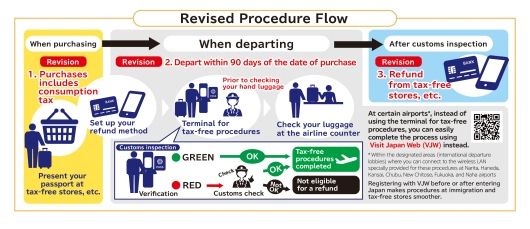
Source: 国土交通省ウェブサイト (MLIT Website), reproduced unmodified under the Government of Japan Standard Terms of Use.
The clearest benefit is the end of the two-basket rule. Right now cosmetics, snacks and medicine count as consumables while clothes, bags and electronics count as general goods, each needing to clear ¥5,000 on its own. You can combine them, but the moment you do, your general goods are sealed and treated as consumables, so the jacket you just bought is bagged shut and cannot be worn until you leave.
From November that trade-off disappears. Anything in one basket counts toward the same ¥5,000 before tax at one participating store on one day, and nothing gets sealed. Buy ¥3,000 of snacks alongside a ¥2,500 T-shirt and the pair clears the threshold together, with the shirt yours to wear that evening.
The snacks are a different matter. Consumables must still leave Japan unused, and removing the packaging rule does not change that. Nothing you can eat, drink or apply should be opened before you fly.
This will be especially useful at stores such as Don Quijote, where a normal basket is already half consumable and half not, and at every drugstore and cosmetics counter where people were splitting purchases to make the maths work. The same applies to variety and lifestyle stores and stationery shops, where individual items are cheap enough that the threshold was the whole problem.
Nothing about your eligibility changes. What changes is when the money leaves your account. An item priced at ¥200,000 before tax costs ¥220,000 at the register, and you get the ¥20,000 back only after Customs has confirmed the goods on your way out.
That is a real constraint on a trip where the shopping is the point. A knife from Kappabashi, a suitcase to carry everything home, a pair of selvedge jeans, a limited release or a bag from one of the Japanese makers are each large enough that the deferred tax is worth planning around rather than discovering at the register.
Two practical consequences. Card limits that were comfortable under the old system may not be, and you cannot receive the refund until Customs has confirmed the goods, so it cannot fund anything else on the trip. When it actually arrives then depends on the retailer’s method.
Above about ¥1,000,000 before tax there is paperwork as well as money. Identifying details such as serial numbers are recorded against the purchase, so carry the certificate, warranty or box documentation to the airport rather than packing it in the hold.
This is the part most coverage leaves out. The refund method is the retailer’s choice. It may be returned to a card or bank account, paid through an app, or collected in cash at the departure point. Japanese regulations also permit other arrangements, including store points or facility vouchers, though that does not mean most retailers will use them.
Ask two questions at the register, before the card goes in. How will the refund be paid, and will a provider fee be deducted. The government charges nothing, but a retailer may pass on its refund provider’s fee. On a small purchase the answer barely matters. On a ¥30,000 tax bill it decides whether you get money or credit at a shop you are about to fly away from.
Tax-free has always needed two things that some of the best shopping in Tokyo cannot produce. It needs a participating tax-free retailer, and it needs ¥5,000 before tax at that one retailer on one day.
Arcade play, crane-game prizes and most vending-machine purchases are not processed as tax-free retail purchases, so the gachapon and crane game guides describe spending that was never eligible. Among smaller independents, eligibility depends on whether that particular shop participates, which is worth checking before counting on a refund at a secondhand or vintage shop, an oripa counter or a single-room card shop. Many larger chains participate, but it can vary by branch. Look for the tax-free sign or ask before you build a basket around it.
Separately, and in force since April 2025, you can no longer qualify by mailing purchases home yourself. Ask the store whether it offers direct international shipping instead.
The obligation does not end at the terminal either. Goods claimed tax-free have to leave Japan without delay, and if they do not, the tax can be collected afterwards with penalties on top. If you do end up consuming something you claimed, the official instruction is to tell a customs officer rather than run the refund procedure anyway.
Arriving in October and leaving in November is the one case worth thinking about, because the rule that applies is the rule on the day you buy. An October purchase is refunded at the register under the old system. A November purchase is refunded after the customs step under the new one, and the two do not combine into a single claim.
Neither is cheaper. The saving is the same either way, so this is a trade between convenience and flexibility. Buying in late October keeps the money in your account and skips the departure procedure. Waiting until November merges the thresholds and drops the sealing, at the cost of paying the tax upfront and completing the customs step before you check a bag.
The rules here follow the Japan Tourism Agency’s own guidance on the refund method, published by MLIT. Prices and shop participation change, so check at the register rather than treating any guide, including this one, as the last word.
You now front the tax, so a 200,000 yen shopping day needs 220,000 yen of available credit. The refund arrives after departure and cannot fund the rest of the trip.
At Narita, Haneda, Kansai, Chubu, Fukuoka, New Chitose and Naha you may complete the tax-free procedure through Visit Japan Web on dedicated airport Wi-Fi before the security check, instead of waiting at a terminal. Everywhere else it is the terminal in the departure lobby.
Card, bank transfer, app, cash and store points are all permitted, and a provider fee may be deducted. Ask both questions before paying, not at the airport.
The terminal sits in the international departure lobby, before baggage check-in, and you must still have every item with you. A green result finishes the customs step, a red one sends you to the inspection area. Weigh the wait against the sum: a few hundred yen back on snacks may not be worth the time in line.
The customs procedure has to be completed within 90 days of the purchase. This only affects long stays, but it affects them absolutely.
One store, one day, 5,000 yen total across anything. The old split between consumables and general goods is gone, so stop planning purchases around it.
A jacket bought alongside snacks is yours to wear. Food, drinks, cosmetics and medicine must still leave Japan unused, and opening one can cost the refund on the whole purchase record.
On 1 November 2026. There is no transition period. Purchases made on 31 October follow the old rules and purchases made on 1 November follow the new ones.
Yes. The 5,000 yen minimum before tax, at one store on one day, is unchanged. What changed is that everything in the basket now counts toward it together.
Not necessarily. The method is the retailer’s choice and may be a card or bank refund, an app payment, cash, or store points and vouchers. A provider fee may also be deducted. Ask at the register rather than assuming.
General goods, yes, and more easily than before, because sealed packaging is abolished. Consumables must still leave Japan unused, and consuming one can make every item on that purchase record ineligible.
The 500,000 yen ceiling on consumables is abolished. Large cosmetics, tea and whisky purchases that had to be split across days no longer do.
Not by mailing them yourself, which stopped establishing eligibility in April 2025. Some stores offer direct international shipping, so ask before you buy.
Only where the shop is a licensed tax-free retailer, which is patchy among small independents and normal among larger chains. The goods being used does not disqualify them. Whether that particular shop participates is what decides it.
At seven airports, yes. Narita, Haneda, Kansai, Chubu, Fukuoka, New Chitose and Naha let you complete the procedure online through Visit Japan Web on dedicated Wi-Fi before the security check. At every other airport and seaport you use the terminal in the departure lobby. Either way it happens before you check a bag, and you must still have the goods with you.
We track what locals and critics actually rate, then send the guides worth planning a trip around. No spam, unsubscribe anytime.

Food And Drink


Food And Drink